
Centre Point
And a sporadic soaking
There cannot be many post-war buildings which have stoked up as much controversy as Centre Point, the 34-storey tower that looms over the junction at the east end of Oxford Street, Tottenham Court Road, and Charing Cross Road. The tower block has just turned 60, having been officially opened on 19th May 1966. Designed by Richard Seifert, this brutalist building was, when completed at 398ft, the second-highest in London.
According to the excellent Modernism in Metro-Land Substack, the building was constructed of Y-shaped structural units, terminating with a crinkled roofline and name sign, just above the top floor. The units were manufactured in Dorset and transferred to the site overnight, allowing the tower to be built quickly, with a storey completed every week. This method of prefabricated construction also eliminated the need for large amounts of scaffolding, unlike the recent upgrade to residential accommodation, which had the entire structure encased with scaffolding. Stability for the giant tower was achieved by using closed-packed piled foundations and relatively light, thin floor slabs in the building itself.
The controversy did not stop at its uncompromising design, as the building remained empty long after its completion. Centre Point’s developer, Harry Hyams, sat on a rising asset, as its capital appreciation far outweighed the rental income, with the added bonus that the unlet office block did not attract rates. This led to Centre Point becoming a symbol of inequality, with a homeless charity named after the building and it being occupied by protesters in 1974.
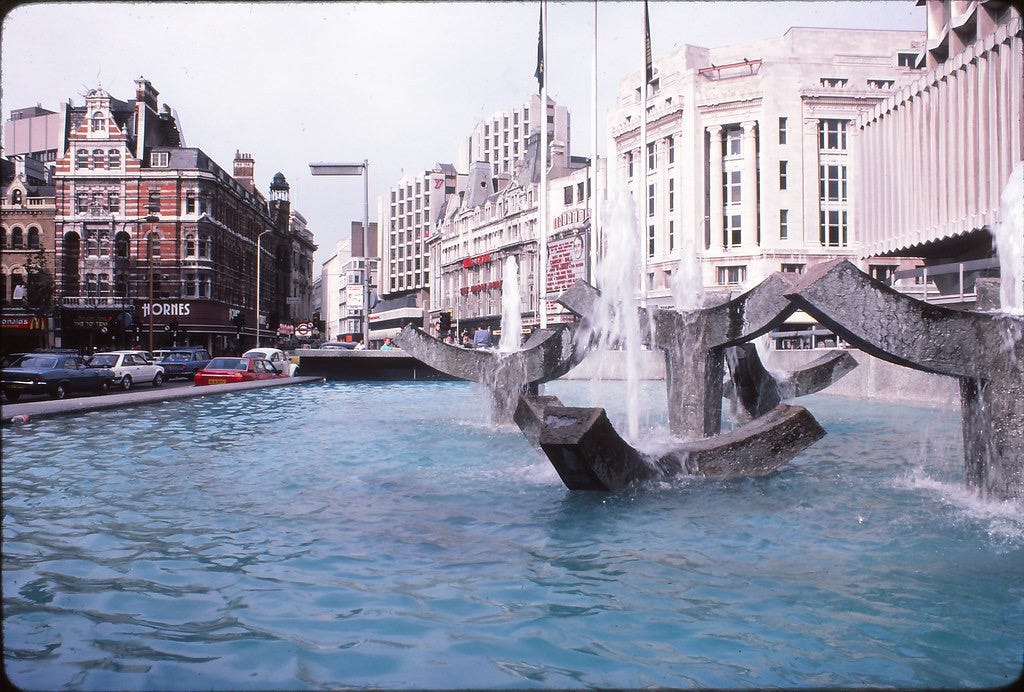
Iconic fountains
The fountains, nestled at the windy base of the building sprayed pedestrians, caused by a downdraft from the wind hitting its upper floors. Standing on a blue mosaic-lined pool, five triple-tined Y-shaped fountains designed by German designer Jupp Dernbach-Mayen, who built the fountains at his Swiss Cottage studio in 1963, reflected the Y-shaped units on the building’s exterior. The fountains were inspired, according to Mireille Burton, the artist’s daughter, by designs he had seen at Alhambra, Granada, in Spain.
Operators of these fountains had an idiosyncratic approach to when they should be turned on. On hot summer evenings, girls waiting for the Astoria to open would sit on the fountain’s perimeter wall staring at an empty pool, safe in the knowledge they would remain dry. On windy winter nights, hapless pedestrians walking past would get soaked.
Wonky Pyramids
Now where these iconic Grade II-listed fountains once stood stands the gleaming new station for Crossrail, with its two wonky glass pyramids, which the designers describe as crystal sculptural forms. Apparently, the fountains were removed to make way for the ventilation shafts for the new enlarged ticket hall. Transport for London refused to return the fountains to their original location because it was ‘simply not relevant to put something back that does not function.’
Public Campaign
When the fountains’ removal was threatened, a public campaign was launched in 2009 to find them a new home. Various locations were suggested, including Whitestone Pond in Hampstead, where Dernbach-Mayen had been resident. Finally, through the intervention of the artist’s daughter and her husband, the fountains were given to the Architectural Association.
Apparently, the fountains are to be restored and will be installed at the site of the Association’s school for rural architecture at Hooke Park in Dorset. Whether the fountains will be available for the public to view and positioned in a blue-tiled pool remains to be seen.
Those infamously sporadic concrete flower fountains will be missed, though…
I must have been one of the few people who loved Centre Point at the time. I thought it was a great example of Brutalist architecture. The money-making policies of not letting the offices to save paying rates soured that for me though.
Cheers, Pete.