
Leather Lane
...and the absence of bovines
It is Monday, 14th January 1963 and I was about to experience the start of life beyond the schoolroom. The previous December London had experienced its last great smog before the Clean Air Act banned coal fires, and not content with that, the weather gods then snowed on the night of the twelfth December. It was to be a prelude to the coldest winter for over 200 years, with the sea freezing for a mile offshore, only the hot discharge from Battersea and Bankside power stations prevented the Thames from freezing over.
My duties as a junior apprentice, paid the princely rate of £5 a week, was to sweep the floor and then go out to buy the men’s lunch, all the time praying that the freeze would end, as even in London snow covered the pavements to a depth of over 1ft, the thaw not arriving until early March.
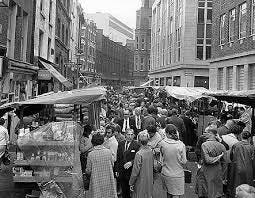
Some trade union activist had discovered that if the temperature hadn’t reached 60.8°F after one hour at the factory, the staff didn’t have to continue working. This, needlessly to say, did not include the junior apprentice trudging through the snow to get their provisions, which included cigarettes, filled rolls and getting the odd pair of false teeth repaired. Nearby Leather Lane with its market running parallel to Hatton Garden was where I would buy the provisions.
If you expect it to be the centre of London’s leather goods market you will be disappointed. The leather trade once centred around Bermondsey Street now commemorated with Leathermarket Street, Morocco Street and Tanner Street.
The story of Leather Lane is more interesting and if local legend is to be believed, more regal.
King Charles II would like to have a punt on the horses and at one time found himself owing £500 to a local merchant named Le Vrunelane after a wager on two horses that lost. To pay off the debt the canny merchant offered the King a way out if he was granted a charter to set up a market and receive 1p on each customer. The market, without a hint of vanity, was named Le Vrunelane and after a number of derivations was Anglicised to Lovreland, then to Liver Lane and finally Leather Lane.
Another explanation for its name is said to come from the old French word for a greyhound – leveroun, it was probably the name of a local tavern, nowadays the French word for a greyhound is spelt leveier.
Whether it got its name from a foolish king or the local boozer, by the 1960s it had shaken off its 19th-century description of being ‘a very poor neighbourhood . . . much invested with thieves beggars, and Italian organ-grinders’. It was a melting pot of culture, class and countries.
Working at that time near Leather Lane’s junction with Clerkenwell Road the area still had an Italian ambience, if lacking the odd organ-grinder. Delicatessens with strange sausages hanging from the ceiling; a tobacconist who had a permanent flame emitting from a pole on his counter enabling customers to smoke his wares; greengrocers stocking exotic fruit: mangoes, lichees and kiwi; a work colleague would take a rarely seen avocado as a thank you gift when invited to dinner.
A thriving Italian community had established itself in Clerkenwell since 1850; with St. Peter’s Catholic Church, and even an Italian Driving School, the Scuola Guida Italiana.
Next door to the factory, above an Italian barber, was a large plaque commemorating that Giuseppe Mazzini and Giuseppe Garibaldi had formed a ‘Workmans’ Society’ in their names promoting the unification of Italy meeting there from 1877.
About this time I wouldn’t have been described as svelte, garibaldi conjured up the image of a thin oblong biscuit liberally sprinkled with what looked like mouse droppings. So it came as somewhat of a revelation that an Italian revolutionary should take as his surname something eaten by the English with a cup of tea. After exhaustive research, I’ve discovered Italians have a propensity to name themselves after biscuits. Peak Freans factory in Bermondsey was so large the area was called ‘Biscuit Town’. They in addition to garibaldis allowed the powerful Italian Burbon family to name themselves after a chocolate coloured biscuit tasting nothing like chocolate.
In Leather Lane market a man sold cheap china dinner services, “how much will you give me ladies for this fine English bone china” while stacking and balancing the entire 6-piece set on his arm. One stallholder made living selling old comics another sold second-hand clothes.
The local wide boys were grateful for the requirement at the time that policemen had to be nearly 6ft tall wearing a uniform topped off by a high helmet. They would see the coppers coming towards them through the crowd as they towered over the regular market-goers. It took seconds to scoop up their wares into a readily waiting suitcase and retire to the local café which helpfully provided benches under which their stolen booty could be hidden.
Many had a natural ‘gift of the gab’. Comedian Tommy Cooper was once a market trader in Leather Lane Market, Tommy was very tall and certainly would have had no trouble spotting an approaching policeman.
As a theatre of commercial and cultural endeavour struggling to recover from austerity, if you wanted to see post-war life, there was no better place to look than in Leather Lane.